Some wildlife destinations are good for sightings. Some are good for landscapes. A few are good for both.
Bandhavgarh is one of those rare places where a photographer doesn’t have to choose.
You go there expecting tiger sightings, of course. That’s the obvious draw. But what makes the reserve memorable isn’t just the chance of seeing a tiger. It’s the way the forest keeps changing the mood of your photographs.
One drive feels intimate and shadowy inside the sal forest, another opens into a meadow where everything suddenly looks cinematic.
That’s what makes Bandhavgarh stand out as a wildlife photography India safari experience. It gives you variety without making the forest feel inconsistent.
The First Safari Tells You What Kind of Place This Is
My first morning in Bandhavgarh didn’t begin with a tiger. It began with the usual half-awake safari routine: cold air, low conversation, and that feeling that everyone is waiting for the jungle to wake up properly.
Then the guide started noticing things.
A langur calling from one side. Deer looking too long in the same direction. Fresh pugmarks crossing the road. Nothing dramatic, but enough to shift the energy in the jeep.
That’s what stayed with me from the first safari. The build-up.
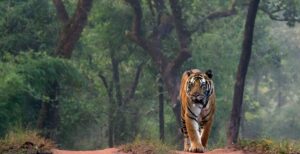
When the tiger finally appeared, it wasn’t a grand, cinematic moment. It simply stepped out of the grass, crossed the road, and disappeared again. The sighting lasted seconds.
The Light in Bandhavgarh Does a Lot of the Heavy Lifting
Some forests are visually rewarding but difficult to photograph. You get wildlife, but not always in flattering light or clean conditions.
Bandhavgarh can be tricky too, but when the light works, it really works.
Morning safaris are especially rewarding because the light tends to be soft and directional. It moves through the forest in layers, catches dust on the road, and adds texture without making the frame feel harsh.
That matters more than people think.
Good wildlife photography isn’t only about seeing an animal. It’s about seeing it in the kind of light that actually makes the image worth keeping.
A wildlife photography India safari becomes much more satisfying when the environment helps you instead of fighting you.
The Meadows Change the Kind of Pictures You Come Back With
This is probably one of Bandhavgarh’s biggest advantages.
Open meadows give photographers something dense forests often don’t: space.
That space changes your images in a few obvious ways:
- The subject stands out more clearly
- Backgrounds feel less cluttered
- Wider compositions become easier
- The animal feels part of a landscape, not just a close-up subject
A tiger walking through grassland creates a completely different photograph from a tiger half-hidden in thick woodland. Both can be beautiful, but the meadow frames often feel more open and balanced.
For photographers who like environmental shots, Bandhavgarh gives plenty to work with.
It Isn’t Just a Tiger Destination
That’s the thing about a strong wildlife photography India safari destination. It keeps the safari worthwhile even when the main subject doesn’t show up.
And, this is where a lot of first-time visitors get it wrong.
They arrive thinking Bandhavgarh is only about tiger photography. It isn’t.
On different drives, you can end up photographing:
- crested serpent eagles in soft morning light
- langurs sitting high in backlit trees
- jackals crossing dusty tracks
- spotted deer in golden grass
- owls hidden inside tree hollows
And honestly, some of those images can be more satisfying than the obvious tiger frame.
Different Parts of the Park Give You Different Moods
One of the most useful things about Bandhavgarh is that the reserve doesn’t look the same all the time.
Some areas feel tight and enclosed. The forest presses in, the roads are narrower, and the photographs tend to feel closer and more intense.
Other stretches feel much more open. You get longer sightlines, wider backgrounds, and a stronger sense of place in the frame.
As a photographer, that variety matters because it stops your portfolio from looking repetitive.
You’re not coming back with twenty versions of the same tiger-on-the-road image. You’re getting:
- close forest portraits
- wider meadow compositions
- atmospheric morning frames
- small wildlife moments between big sightings
That mix is a big part of Bandhavgarh’s appeal.
The Best Thing It Teaches You Is Patience
I went there thinking mostly about camera settings, tiger movement, and lens choices.
I came back thinking more about patience.
Bandhavgarh rewards photographers who are willing to slow down and watch the forest properly. Not every memorable image comes from a tiger sighting. Sometimes it’s a deer turning into the light at the right moment, or a bird staying on a perch just long enough for the fog behind it to clear.
Once you stop treating the safari like a countdown to the next big sighting, the reserve starts giving you much more.
That’s when the photography gets better, too.
Why Photographers Keep Returning
There are plenty of places in India where you can photograph wildlife. But Bandhavgarh has a way of staying in your head after the trip ends.
Part of that is the tiger density. Part of it is the variety in the landscape. And part of it is the simple fact that the reserve gives photographers room to make different kinds of images instead of repeating the same frame all day.
That’s why it remains such a strong wildlife photography India safari destination.
You still need luck. You still need timing. And no forest gives you everything on demand.
But Bandhavgarh gives you enough possibilities to keep you thinking about the next drive even before the current one ends. Book your safari.
FAQs
- Is Bandhavgarh a good place for beginner wildlife photographers?
Yes, it’s one of the easier places to start because you get a mix of strong wildlife movement, varied landscapes, and regular photography opportunities. You don’t need to be an expert to come back with a few memorable frames.
- What makes Bandhavgarh different from other wildlife parks for photography?
A big part of it is the mix of tiger sightings, open meadows, sal forest, and smaller wildlife moments in between. It doesn’t feel like you’re photographing the same scene over and over.
- Which season is best for a wildlife photography India safari in Bandhavgarh?
That depends on the kind of images you want. Winter gives you softer light and atmosphere, while summer usually improves visibility and wildlife movement.
- Is Bandhavgarh only good for tiger photography?
Not at all. Birds, deer, jackals, langurs, and even the landscape itself can make the safari worthwhile from a photography point of view.
- How many safaris should a photographer plan in Bandhavgarh?
Ideally, at least four to six drives if you want a proper mix of sightings, light conditions, and different parts of the reserve. One or two safaris can still be enjoyable, but they don’t give you much room to explore the place properly.